
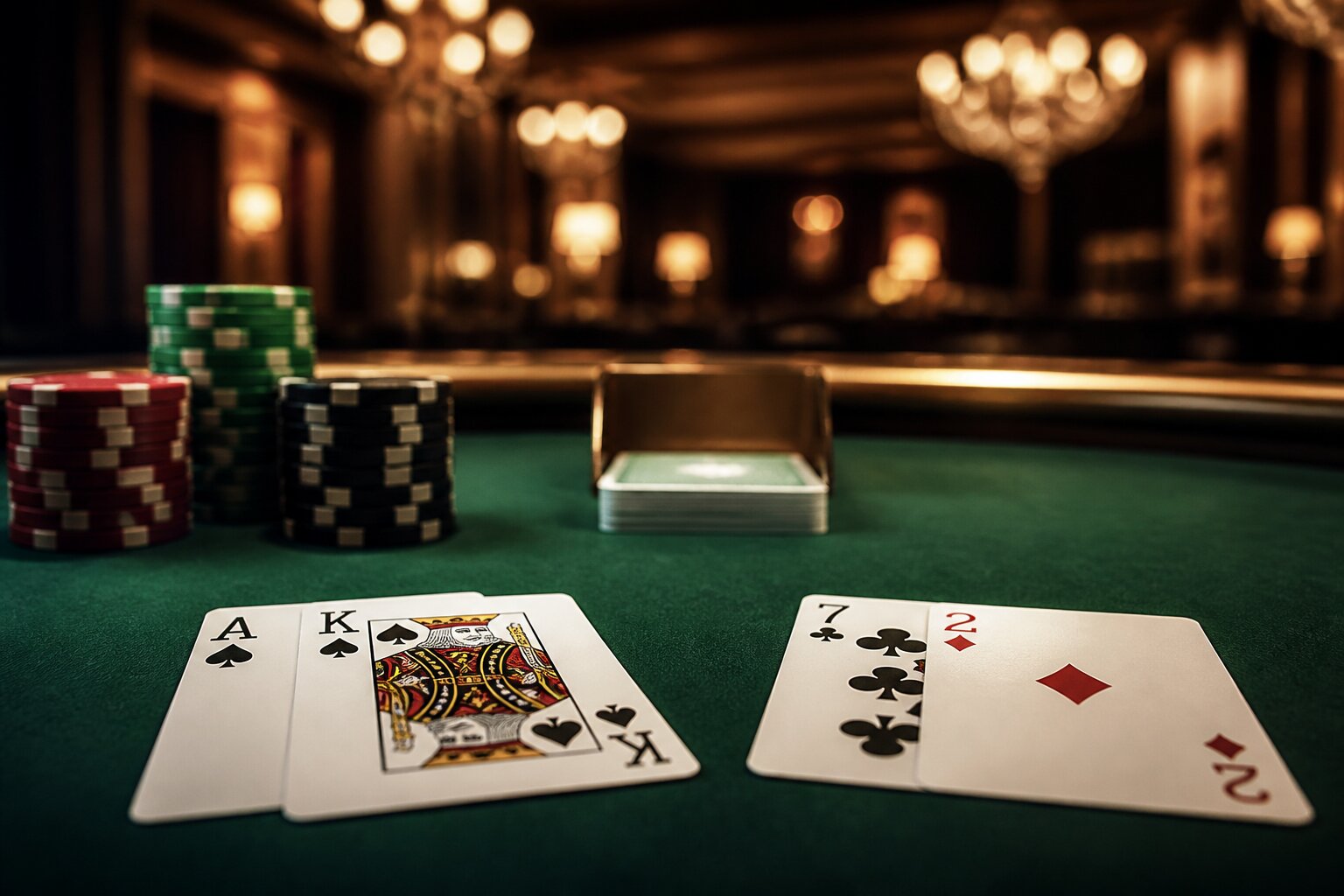
Ever sat at a blackjack table and wondered if your cards were as good (or bad) as you thought? Knowing which hands give you the strongest chance of a favourable result—and which ones tend to cause dilemmas—can change how you think about each round.
This guide walks through the hands that set you up well, the ones that create awkward choices, and the key differences between flexible and rigid totals. Whether you’re new or brushing up, the aim is to make the reasoning behind each hand clearer so you can act with more confidence.
Ready to see where your starting cards fit into the ranking? Let’s go through the hands and what they really mean for the game.
What Makes a Blackjack Hand Good or Bad?
A hand’s value comes down to the mathematics of getting closer to 21 without going over, and the options it leaves you with as the round unfolds. Good hands tend to be those that already put you near 21 or offer flexibility in how you treat the ace. Bad hands are ones that leave you exposed—either too close to busting if you hit, or too far from 21 if you stand.
Hands containing an ace are often valuable because the ace can be treated as 1 or 11, giving you two possible totals. Two-card totals of 20 or 19 are also strong: they rarely need improvement and often force the dealer into a difficult position. Conversely, totals between 12 and 16 are tricky; they are “stiff” because taking another card risks busting, yet standing may leave you behind.
Understanding these tendencies helps you judge whether to play conservatively or wait for the dealer’s outcome. Next, we’ll look at how those tendencies are organised into common ranking categories.
Blackjack Hand Rankings Explained
Rankings group hands by how favourable they are at the moment you see them, not by any absolute guarantee. At the top sits a two-card 21, followed by high totals like 20 and 19, then middle-range hands from roughly 13–18, and finally the weaker hands under 13.
A two-card 21 has a special status because of its payout and settlement rules; beyond that, tens and high combinations command strength because they minimise the chance of needing risky hits. Middle-range hands contain more nuance—soft hands within that band can be played more aggressively because the ace reduces downside. Low totals are weak simply because they need more improvement to be competitive.
These categories describe typical outcomes and probabilities rather than certainties. To make those ideas concrete, the next section focuses on the very best starting hands.
Which Are the Best Starting Hands in Blackjack?
The strongest possible start is a two-card 21 made of an ace and a ten-value card. This combination has a special settlement in most games and ends the hand immediately unless the dealer also has the same two-card total.
Other strong starts include any total of 20—often two ten-value cards or an ace plus nine. Twenty gives you a commanding position because the dealer must often draw to reach competitive totals, and your risk of busting by taking another card is negligible, so standing is normally the sensible choice.
Totals of 19 are also solid. They rarely improve and typically hold up well against many dealer outcomes. These high starting totals let you concentrate on how the dealer plays rather than chasing improvement yourself.
With those strong hands in mind, it’s useful to contrast them with the ones that cause the most trouble.
Which Are the Worst Starting Hands in Blackjack?
The most difficult starting zones are the so-called “stiff” hands—totals from 12 to 16. These hands force a tense decision: taking a card risks busting, but standing might leave you short of the dealer’s final total. For example, a 10 and a 6 or a pair like 9 and 7 fall into this category.
Very low totals, such as 8 or 9, are uncomfortable for a different reason: they require several successful draws to become competitive. While they are safe from immediate busting, the path to a strong total often needs multiple favourable cards.
These hands don’t signal an automatic loss; they simply require more careful evaluation of the dealer’s visible card and how the remainder of the round might play out. That evaluation is easier when you recognise whether your hand is hard or soft.
How to Identify Hard and Soft Hands in Blackjack
Hard and soft labels describe the presence and treatment of an ace in your hand. A soft hand contains an ace that can be counted as 11 without busting, giving two possible totals. A hard hand either lacks an ace or has an ace that must be counted as 1 to avoid going over 21.
Soft hands offer more flexibility: for instance, an ace and a six can be thought of as 7 or 17, which affects how you react to the dealer’s up-card. Hard hands are less forgiving because every additional card increases the immediate risk of busting.
Recognising this distinction helps you weigh risk versus reward in the moment. The examples below illustrate typical hard and soft hands and why they behave differently.
Common Examples of Hard Hands
These examples show hands where there is no ace counted as 11, so choices are more constrained.
10 and 7 (hard 17): A stable total with limited upside.
9 and 8 (hard 17): Similar stability but no ace flexibility.
Ace, 6, and 10 (hard 17): The ace must be counted as 1 here to avoid busting.
Common Examples of Soft Hands
Soft hands include an ace that can switch value, creating safer opportunities to draw.
Ace and 6 (soft 17): Can be treated as 7 or 17.
Ace and 5 (soft 16): Gives room to hit without the same bust risk.
Ace, 3, and 4 (soft 18): Flexibility that can be used strategically as play unfolds.
With the types of hands clear, it helps to spell out what makes a two-card 21 different from other similar totals.
What Is a “Natural” Blackjack and Why Is It Important?
A “natural” blackjack is a two-card 21 made from an ace and a ten-value card dealt as your first two cards. It is distinct from a 21 reached in three or more cards because it usually receives a different payout and settles immediately unless matched by the dealer’s own natural.
This distinction matters because it affects how the round resolves: a natural typically pays at a higher rate than a standard win and forces an immediate evaluation against the dealer’s initial cards. The probability of receiving a natural is lower than many common hands, which is why its financial effect is notable when it happens.
Understanding the special status of the natural helps clarify why players treat a two-card 21 differently from other 21 totals.
What Are Draws or Pushes in Blackjack?
A draw, or push, happens when your final total equals the dealer’s; neither side wins or loses and your stake is returned. Pushes occur with any total, though they are frequently seen when both sides end on mid-to-high totals like 17–20.
Soft hands can contribute to pushes because the ace’s dual value allows you to avoid busting and reach totals that the dealer can also achieve. The takeaway is that pushes are part of normal play—an outcome that simply ends the round without a win or loss.
Now that we’ve covered outcomes, let’s clear up some common misunderstandings about specific hands.
Frequently Misunderstood Blackjack Hands
Some concepts repeatedly cause confusion. One is the natural blackjack: only a two-card ace plus ten-value combination qualifies, not a 21 formed from more cards. Another is pairs and splitting—two aces, for instance, are powerful, but splitting creates separate hands that are played independently and usually do not qualify as naturals afterwards.
Players also misjudge soft hands, thinking their presence guarantees safety. Soft hands reduce the immediate risk of busting, but they do not ensure a favourable final total; subsequent cards and the dealer’s sequence determine the result.
Clearing up these points helps you interpret what your hand actually means in the round and reduces mistakes born of misconception.
Common Myths About Blackjack Hand Strength
A few persistent myths can colour decision-making at the table. Recognising and correcting these false ideas helps players make choices based on probability and the real mechanics of the game, rather than on misconceptions that often lead to poor decisions.
Common myths include:
- A push is a loss. In reality a push simply returns the stake to the player; no money is won or lost on that particular hand.
- Soft and hard hands with the same numeric total are equivalent. Soft hands usually allow more options because the ace can count as 1 or 11, which changes the risk profile and the correct play.
- A particular hand is “due” to win because of earlier rounds. Each deal is independent; prior outcomes do not change the underlying probabilities for the next hand.
Understanding these points makes it clearer why basic strategy and probability are the useful guides. Staying aware of how the game actually works reduces reliance on superstition and helps maintain responsible play.
Final Thoughts on Blackjack Hand Rankings
Understanding hand rankings gives you a clearer lens for evaluating each round. High two-card totals and hands with an ace generally offer more options; stiff hands demand more careful judgement. Knowing the difference between a natural blackjack and other 21s, and how pushes work, removes much of the mystery at the table.
If you keep these principles in mind—what a hand can do, how flexible it is, and how it compares to likely dealer outcomes—you’ll find the game easier to read and the decisions more confident. Play within sensible limits and enjoy applying what you’ve learned each time you sit down.
**The information provided in this blog is intended for educational purposes and should not be construed as betting advice or a guarantee of success. Always gamble responsibly.