
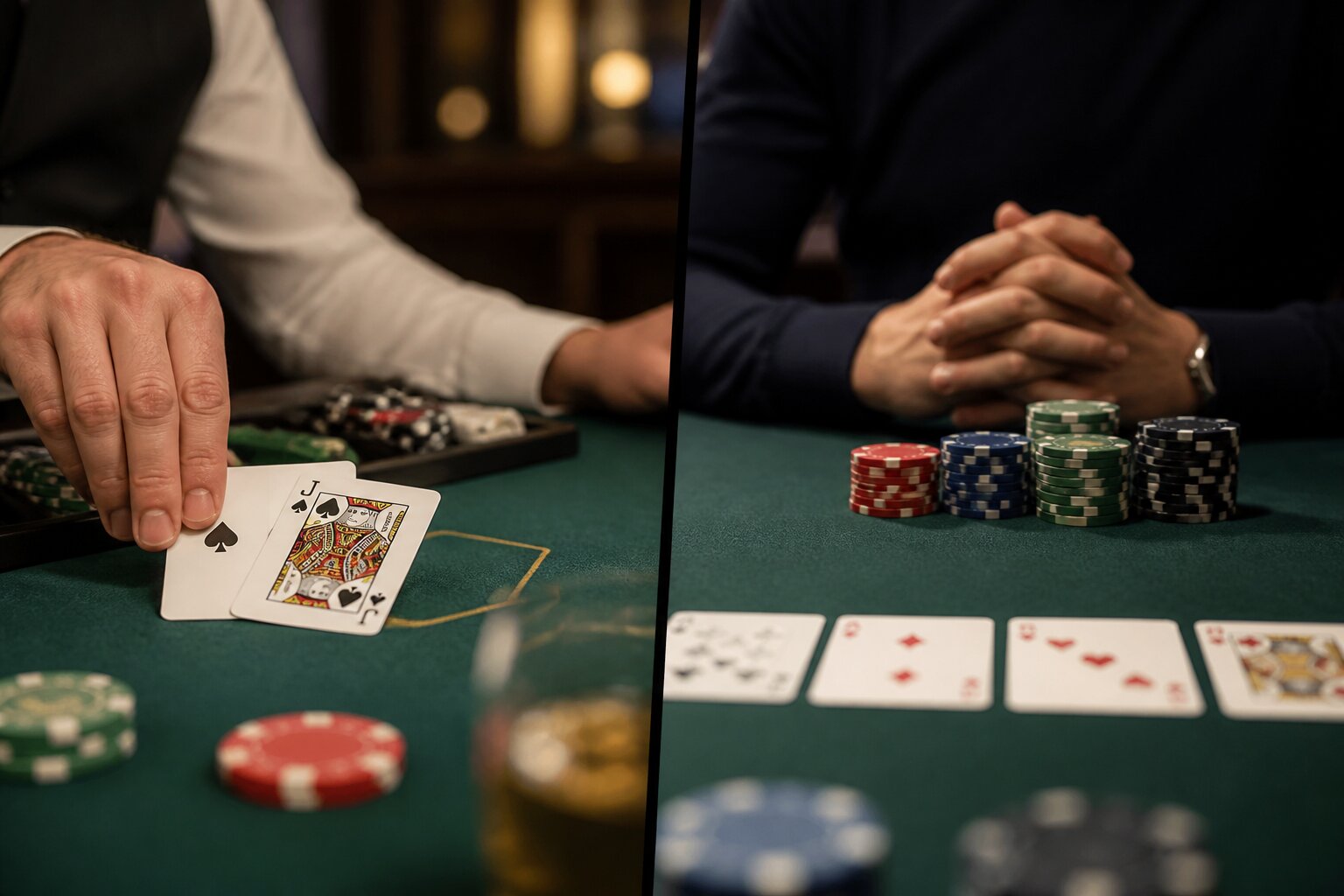
Looking to make the most of your time at the casino table but unsure whether to pick blackjack or poker? You’re not alone. Both games attract millions of players, yet they offer different paths to profit and different demands on your skills.
You may have read about poker players winning big or about blackjack strategies that reduce the house advantage. Which game truly gives you the better chance of finishing ahead depends on several practical factors, from how winnings are calculated to how much skill you can bring to the table.
Whether you prefer playing online or in a venue, the details that follow will help you compare potential returns and decide which game suits your goals and style.
What Are the Main Differences Between Blackjack and Poker?
Blackjack and poker sit side by side on the casino floor but are fundamentally different in how they operate and what they ask of a player. Blackjack is a game of scoring against a fixed target, while poker is a contest of relative hand strength and betting dynamics. Each game appeals to different strengths and preferences.
Who You Play Against
In blackjack you compete only with the dealer, aiming to beat the dealer’s hand without exceeding 21. The dealer follows a set of house rules, so your decisions are made against predictable behaviour.
Poker pits you against other players; the objective is to make the best hand or to use betting to force opponents out of a pot. Opponents’ actions and tendencies create a changing strategic landscape that you must adapt to.
Game Structure
Blackjack rounds are short and decisions are immediate. On each hand you will choose from a small set of options:
- Hit
- Stand
- Double down
- Split
After those decisions the outcome is resolved quickly and the next round begins. This makes blackjack well suited to shorter sessions and a faster pace of play.
Poker unfolds over multiple betting rounds, with play styles and strategies evolving as the hand progresses. Players must consider the changing information revealed by bets, community cards and opponents’ behaviour, so sessions typically last much longer and can involve more sustained strategic thinking.
Skill vs Chance
Blackjack combines probability with decision-making: the way you play a specific hand affects the expected outcome. Good basic strategy reduces the house edge, and decisions are often made with reference to mathematical expectations and known probabilities.
Poker places a greater premium on long-term skill. Success depends on a wider range of player skills, including:
- Reading opponents and identifying betting patterns
- Position play and how seating affects decision-making
- Bet sizing and managing pot control
Over many hands, skilful players can gain an advantage, because poker rewards psychological insight, adaptability and strategic planning in addition to technical knowledge.
Payouts
Blackjack payouts are fixed by the rules: standard wins usually pay even money and certain hands, like a natural blackjack, pay a higher rate. Side bets and variant rules can alter payouts, but the base structure is consistent and transparent.
Poker payouts vary by format and context:
- In cash games you win the chips in the pot for that hand
- In tournaments prizes are distributed according to final positions and the size of the entry pool
If you want to follow this through, the next sections explain exactly how winnings are calculated and how the house extracts its share.
How Are Winnings Calculated in Blackjack?
Blackjack payouts are simple and immediate, tied to the result of each round.
A standard win typically pays 1:1, so a £10 bet returns £10 in profit plus the original stake. A natural blackjack, usually an ace plus a ten-value card, commonly pays 3:2 (so a £10 stake returns £15 profit). When you and the dealer tie, that is a push and your stake is returned. If the dealer wins, you lose the bet.
Some tables offer optional side bets, but these almost always increase the casino’s statistical advantage. Winnings are settled as soon as a round ends, which makes blackjack straightforward to track session to session. Always check the specific table rules before you play, since payout rates and permitted actions can vary.
How Do Poker Payouts Work?
Poker payouts depend on the game format and the distribution of chips or entries.
In cash games, the pot is built from players’ bets each hand and the winner takes that pot. In tournaments, every entry fee contributes to a prize pool, which is then split among the highest finishers according to a posted pay structure. The amounts vary by tournament size and format.
Hand rankings determine who wins a pot at showdown—a straight beats three of a kind, a flush beats a straight, and so on. Strategic actions like folding, bluffing and bet sizing influence how often you collect pots, so skill translates into consistent returns over time for players who outplay their opponents.
Before joining a game it’s sensible to check how the host handles rakes and fees, as these directly reduce the money available to players.
It helps to know how the house makes money before comparing the two games more closely.
House Edge: How Does It Affect Blackjack and Poker Payouts?
House edge describes the casino’s built-in advantage over players across time, expressed as a percentage of all bets.
In blackjack, this edge can be low when players follow sound strategy—often around 0.5% under favourable rules. That means the game returns a high proportion of wagers to players over many hands. Specific rule variations, such as the number of decks or whether dealers hit on soft 17, change this figure noticeably.
Poker operates differently: the operator doesn’t play against you, so there isn’t a house edge in the same sense. Instead, the venue takes a rake from each pot in cash games or charges tournament fees, which function like a built-in cost to play. Over long runs, that rake is the main drag on player profits.
Understanding how each game’s cost structure works helps clarify why experienced players often prefer one game over the other depending on their strengths.
Skill vs Probability: How Do They Impact What You Can Win?
Both games involve decision-making and uncertainty, but the balance between player skill and random variation differs.
Blackjack is governed by the probabilities of card combinations and by the choices you make within each hand. A solid basic strategy reduces the casino’s advantage, but variability in short sessions remains. Expect swings; even with correct play, outcomes over a few hands can differ widely from long-term expectations.
Poker rewards broader strategic skills—reading opponents, selecting spots to bet, and managing your stack across many hands. Skilled players can consistently earn positive returns if they face weaker opposition and control the game’s economics. Yet variance is still present: even the best players will experience losing sessions because of how cards fall and how other players act.
Neither game offers guaranteed wins. Thinking in terms of long-term edge and how your own abilities affect results provides the clearest picture of potential returns.
Now that you’ve seen how chance and skill interact, let’s clear up some common misunderstandings that can cloud judgment.
Common Myths About Blackjack and Poker Payouts
There are a number of persistent misconceptions about how payouts work in both games.
One myth is that any system can guarantee consistent winnings. No strategy removes the underlying variability of card outcomes and opponent behaviour. Another is that streaks or recent results change the odds of future hands; each deal is resolved independently and prior hands do not alter probabilities.
Some assume poker is purely random or that blackjack is only about guessing; both are false. Poker strongly rewards skill over the long run, while blackjack allows players to reduce the house advantage through sound decisions. Finally, chasing losses or assuming a win is imminent based on recent play is a risky outlook—expectation management is key.
Clearing these up helps you set realistic goals and choose the right approach for either game.
Which Game Typically Offers Better Returns for UK Players?
Comparing returns means looking at different measures. Blackjack commonly records some of the highest theoretical returns among casino table games, with return-to-player figures near 99% under favourable rules and correct play. This makes blackjack attractive for players focused on minimising the casino’s statistical edge.
Poker lacks a single return-to-player percentage because outcomes depend heavily on player skill relative to opponents and on fees taken by the host. A skilled poker player facing weaker opponents can achieve returns that beat most other gambling options, but that depends on the quality of competition and on keeping game costs low.
Remember that stated RTP figures are long-run averages. Short sessions can diverge substantially from those numbers, and your personal results will reflect both the rules you face and your own level of play.
With those comparisons in mind, practical choices come down to the next points.
Choosing the Right Game: What Else Should You Consider?
Returns are important, but so are how you like to spend your time and what you can realistically sustain.
Personal Preference
If you favour fast decisions and clear rules, blackjack may suit you. If you enjoy reading people, strategic manoeuvring and a social environment, poker may be more rewarding. Your enjoyment will also influence how well you stick to sensible limits.
Experience and Knowledge
Beginners often find blackjack easier to learn, since the basic strategy can be memorised and applied immediately. Poker requires more time to master, as effective play involves understanding opponents, position and pot control.
Enjoyment and Comfort
Picking a game you enjoy makes it easier to remain disciplined and avoid costly mistakes. Enjoyment should not be a reason to overplay; rather, it helps you stay engaged while applying the approach that best fits your goals.
Finally, make sure you know the table rules and any fees before you start. Play within your means and take breaks when needed—these steps protect both your bankroll and your enjoyment. If you’re ready to try one of these games now, explore tables that match your experience level and check the payout and fee structures before you sit down.
This wraps up the comparison and gives you a clear basis for choosing between blackjack and poker.
**The information provided in this blog is intended for educational purposes and should not be construed as betting advice or a guarantee of success. Always gamble responsibly.