
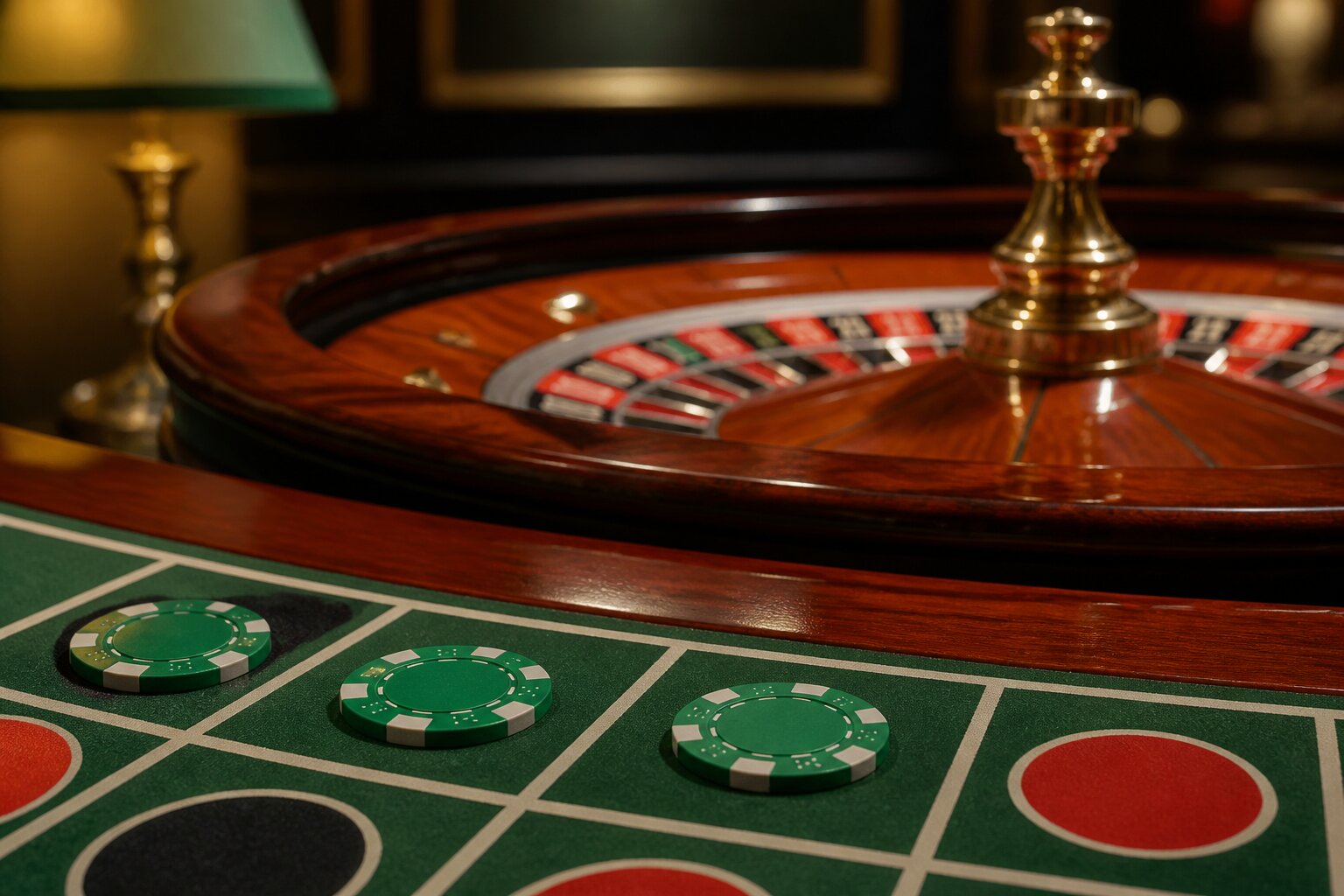
Ever wondered what those green numbers on the roulette table really mean? You’re not alone. Most players spot the reds and blacks straight away, but the green spaces can be a mystery—especially when it comes to how they affect payouts and odds.
If you’ve heard talk of “green payouts” but aren’t sure what’s special about them, this article will explain their role, where they sit on the table and wheel, and how they change the maths of the game. By the end you’ll understand why those green pockets matter and how their position ties into the payouts you see.
Ready to get into the detail? We’ll start with the basics of what the green spaces are and why they’re visually and mechanically distinct.
Understanding the Green Spaces on a Roulette Wheel
The green pockets on a roulette wheel are set apart from the red and black numbers both visually and functionally. In European roulette there is a single green pocket marked 0. In American roulette there are two green pockets, marked 0 and 00. Because they are the only sections not coloured red or black, they immediately stand out to players and dealers alike.
On the layout where bets are placed the green area for 0 (and 00 where present) sits apart from the main number grid, typically at the top of the betting area. That separation signals that these pockets do not belong to the usual categories—red/black, odd/even, high/low—that many outside bets rely on. As a result, when the ball lands in a green pocket those outside bets lose, and only bets explicitly placed on the zero(s) win.
This design gives the house edge a consistent advantage across the table. There are also specific rules in some games—such as variants that return half a losing outside bet when zero appears—that alter outcomes in limited ways, but those are offered only in selected games. Next, we’ll look at why the zeros are treated differently to all other numbers and how that affects play.
Why Are Zero and Double Zero Different from Other Numbers?
Zero and double zero are excluded from the red/black and odd/even groupings, which is the chief reason they change the dynamics of roulette bets. All the other numbers are split between red and black and between odd and even, allowing many bets to cover approximately half the wheel. The green pockets are not part of those divisions, so they interrupt the symmetry that those bets rely on.
That interruption matters because common outside bets—such as red/black or odd/even—would otherwise appear to offer nearly even chances of winning. The green pockets ensure those bets do not cover every outcome, and that produces the mathematical advantage the house requires. Players can still bet directly on 0 or 00 as a straight-up number, and those bets carry the same single-number payout as any other straight bet, but the reduced frequency of green results means the overall odds are different.
This structural difference prevents any betting system from neutralising the house edge. With the role of zeros clear, it’s useful to see exactly where they sit on the table and wheel, which helps to understand how easy they are to spot and to bet on.
Green Numbers: Table Layout and Position
On the betting layout the green numbers are positioned so they’re easy to find. In European roulette the lone 0 is placed at the top of the number grid, visually set apart from the block of numbers beneath. In American roulette the 0 and 00 sit side by side at the top, again outside the main grid. That placement makes it straightforward to put a straight-up chip on a green pocket without confusing it with adjacent numbers.
The wheel itself shows the same separation. On a European wheel the green 0 is positioned among the numbered pockets to balance the sequence of reds and blacks; on an American wheel the 0 and 00 are spaced apart from each other and from neighbouring numbers. The precise ordering of pockets around the rim is designed for even distribution of sectors rather than to match the table layout sequentially, which is why the wheel’s pattern may look quite different from the betting grid.
Because of their distinct placement, green pockets are both easy to identify and consequential to most bets. Understanding this physical setup leads naturally into how those green bets pay out when they do win.
How Do Green Payouts Work in Roulette?
When a bet is placed directly on a green number and the ball lands there, that straight-up bet pays the same as any single-number win: 35:1. That means a successful straight bet returns 35 times the stake plus the original stake. What differs between European and American roulette is the frequency with which a green result can occur, and that change in frequency is what alters the expected return over time.
In European roulette, a straight bet on 0 wins once in 37 possible outcomes, producing the 35:1 payout but also leaving a small house margin because one outcome is not covered by outside bets. In American roulette, with 0 and 00 present, each straight bet on either green number wins once in 38 outcomes, and because there are two green pockets the overall likelihood of a green outcome during a spin is higher than in the single-zero game. That extra green pocket raises the house advantage on many wagers.
Some games include specific rules that adjust how outside bets are treated when zero appears. For instance, variants that refund half the stake or hold the bet for the next spin change the effective risk for outside bets, but those rules are not universal and should be checked for any particular table. Understanding payout parity and pocket frequency gives a clearer picture of what to expect when green numbers are involved.
What Are the Odds of Landing on Green?
The probability of the ball landing in a green pocket is fixed by the number of pockets on the wheel. In European roulette there are 37 pockets in total—numbers 1 to 36 plus a single 0—so the chance of the ball landing on zero on any spin is 1 in 37, roughly 2.70%.
American roulette has 38 pockets—numbers 1 to 36 plus 0 and 00—so the chance of hitting either green pocket in a single spin is 2 in 38, about 5.26%. If the interest is in one specific green number (0 or 00), the probability is 1 in 38, approximately 2.63%.
These percentages describe long-run averages rather than certainties in the short term. Over many spins you would expect outcomes to approximate these probabilities, but every spin remains an independent event. With those odds in mind, players can see why straight-up green bets offer high nominal payouts but occur relatively infrequently compared with other outcomes.
This completes the overview of how green pockets function, where they sit on the table and wheel, how their payouts compare, and what the underlying probabilities are.
Exploring Casino Games at Star Slots
We’d love to welcome you to our community of players and invite you to explore all that our site has to offer. Taking part is a wonderful way to enjoy some entertainment whenever it suits you.
It only takes a few steps to get involved: create your account, make a deposit and you’re ready to play. We’re here to make your experience enjoyable every step of the way.
**The information provided in this blog is intended for educational purposes and should not be construed as betting advice or a guarantee of success. Always gamble responsibly.