
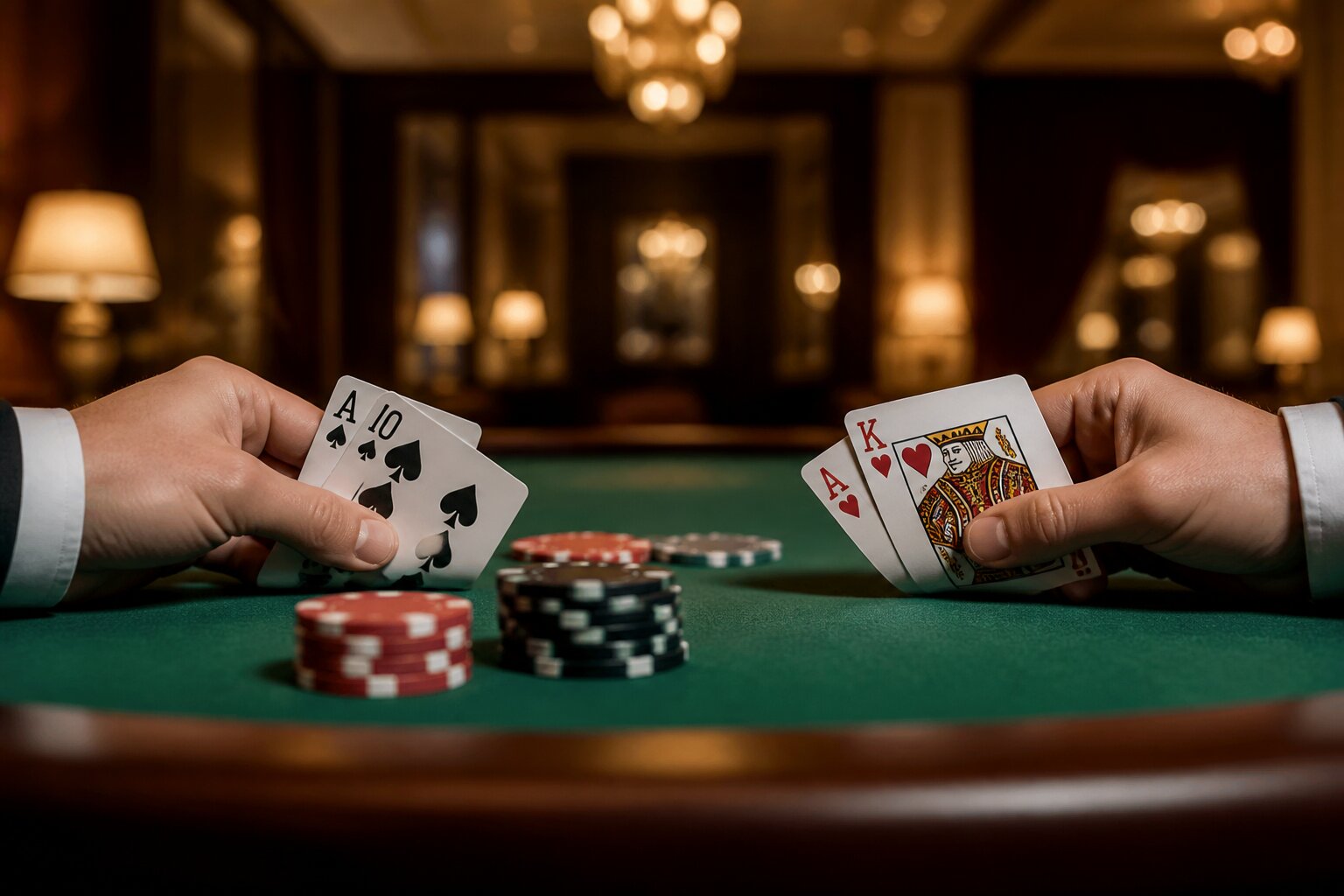
Ever found yourself at a card table and wondered if you’re playing blackjack or pontoon? You’re not alone. Both games look similar on the surface, but the differences matter once you start playing.
Whether you’re a beginner or you’ve been dealt a few hands, mixing up rules, terminology and strategy is an easy mistake. This guide breaks down the essentials clearly, so you’ll know what to expect at the table and which game suits you best.
Read on to discover the key differences, similarities and practical points to help you feel confident when you sit down to play.
What Is Blackjack?
Blackjack is one of the best-known casino card games, prized for straightforward rules and a brisk pace. It’s usually played with one or more standard 52-card decks, and you play against the dealer rather than the other players.
The objective is to get a hand total as close to 21 as possible without exceeding it. Each round begins with two cards for you and two for the dealer, with one of the dealer’s cards dealt face down until later in the round.
Card values are simple: numbered cards count as their face value, face cards count as 10, and aces can count as 1 or 11. If your first two cards total 21, that hand is called a ‘blackjack’ and is the strongest possible result.
During play you decide whether to take another card or keep your total, balancing the potential reward against the risk of going over 21. This mix of decision-making and chance is what gives the game its appeal.
What Is Pontoon?
Pontoon is a close relative of blackjack but uses different conventions that change how the game feels. It also aims for a total near 21, and the best first-two-card hand—an ace plus a ten-point card—is called a ‘pontoon’.
One of the most noticeable differences is how the dealer’s cards are dealt: in pontoon both dealer cards are face down, which keeps the banker’s position more concealed throughout the round.
Terminology shifts a little too. Where blackjack players ‘hit’ or ‘stand’, in pontoon they ‘twist’ or ‘stick’. There is also the option to ‘buy’ a card, which resembles doubling the bet in blackjack but operates under pontoon’s own rules.
Another key rule is that players must twist on totals of 14 or less, which forces more action in low-value hands. Pontoon also recognises the ‘five card trick’—any five cards totalling 21 or less—which ranks highly against most hands.
These differences affect strategy and table dynamics, so it pays to know the rules before you join a pontoon table.
How Do the Rules of Pontoon and Blackjack Differ?
The games share the same objective, but several rule points change the way each round unfolds.
Terminology alters the feel of a session: blackjack’s hit and stand become twist and stick in pontoon, and doubling versus buying shifts how you can increase your stake for an extra card. These are more than words; they shape expectations about what options are available.
Card exposure is another major distinction. Blackjack gives players a partial view of the dealer’s hand with one face-up card, which informs decisions. Pontoon keeps both dealer cards hidden, so players act with less information about the banker’s position.
Mandatory actions also vary. Pontoon’s rule forcing a twist on totals of 14 or less introduces a fixed level of risk that does not exist in blackjack, where players choose freely at every point. And while both games reward an ace plus a ten-point card as the top hand, other hand rankings—like pontoon’s five card trick—are unique and affect outcomes.
These rule differences influence both short-term decisions and overall strategy, so if you switch between the games you’ll want to adapt your approach accordingly.
Card Values & Winning Hands Compared
Card values are consistent across the two games: numeric cards count at face value, face cards are 10, and aces can be 1 or 11 depending on which best suits the hand.
The best possible initial hand in both games is an ace with a ten-point card, but the name differs—‘blackjack’ in one, ‘pontoon’ in the other. That distinction is important because it signals slightly different payout and ranking systems at some tables.
Pontoon adds extra winning categories. The five card trick—five cards totalling 21 or less—outranks most other hands, providing a distinct route to victory that doesn’t exist in standard blackjack. Aside from these special cases, both games follow the simple rule that totals exceeding 21 result in an automatic loss.
Understanding how particular hands are ranked and rewarded in each game helps manage expectations and informs which hands are worth pressing when you have the chance.
Why Do People Confuse Blackjack With Pontoon?
The confusion comes down to shared features and overlapping history. Both games centre on reaching 21, use the same deck structure and card values, and are played against a dealer. Those commonalities make them look like the same game at first glance.
Historically, both evolved from early European card games, branching into regional variants over time. That historical overlap explains why some terms and setups sound similar across countries.
Regional usage of names also adds to the muddle. In the UK, for example, pontoon was historically used as an alternative name, and elements of the rule sets have influenced each other. As a result, players encountering one version without checking the rules can easily assume the others are identical.
A clear look at the rule differences—particularly dealer cards, mandatory actions and special hands—quickly removes the ambiguity.
Which Game Is More Popular in the UK?
Blackjack is more widely played in the UK, appearing in most land-based casinos and on many online sites. Its broader presence and a range of common variants make it the easiest game to find.
Pontoon still has a following, however, especially among traditional players and in certain private or smaller venues. Online, it appears less often but is available in some game libraries and as regional variants.
If availability matters to you, blackjack is the safer bet for finding frequent games; if you prefer the particular rules of pontoon, it may take a little more searching to find the right table.
How Easy Is It to Find Each Game Online and in Casinos?
Blackjack is a standard offering at most casinos and is usually available in many variants, from classic to live-dealer formats. That makes it simple to find a table that matches your preferred pace and stakes.
Pontoon tends to be more niche. You’ll find it in select online game collections and in venues that cater to traditional or regional tastes. When considering where to play, check the game list in advance so you don’t turn up expecting one set of rules and encounter another.
Either way, a quick review of the rules for the specific table you join will keep surprises to a minimum and let you enjoy the session on your terms.
Are There Any Common Myths About Pontoon vs Blackjack?
A few misconceptions circulate that can mislead players. One is that the two games are simply the same with different names; while close, they have distinct rules that change decisions and outcomes.
Another persistent myth is that one game reliably gives you better odds than the other. Outcomes in both games depend on the specific rules and house edge at the table you join, so neither guarantees superior results.
Finally, some people overestimate the effectiveness of card-counting or system play. Casinos employ measures to protect game integrity, and no system removes the element of chance entirely. Knowing the true mechanics and house rules is far more useful than following unproven methods.
Being aware of these points helps you approach each game with realistic expectations and makes it easier to choose the version that fits your style.
Which Game Should You Choose?
Your choice comes down to which rule set you prefer and where you’ll find the game. If you value wide availability and a familiar structure, blackjack is likely the better option. If you enjoy the strategic twists of hidden dealer cards, forced actions on low totals and special hands like the five card trick, pontoon may suit you more.
Whichever you play, treat it as entertainment and set clear limits for time and spend before you start. If you notice your play becoming a problem or you have concerns about your habits, help is available through charities and support services that specialise in gambling-related issues.
If you’re ready to try either game, browse the games on offer here and choose a table that lists the rules you prefer. With the differences clear, you’ll be able to join in confidently and enjoy the session.
**The information provided in this blog is intended for educational purposes and should not be construed as betting advice or a guarantee of success. Always gamble responsibly.