
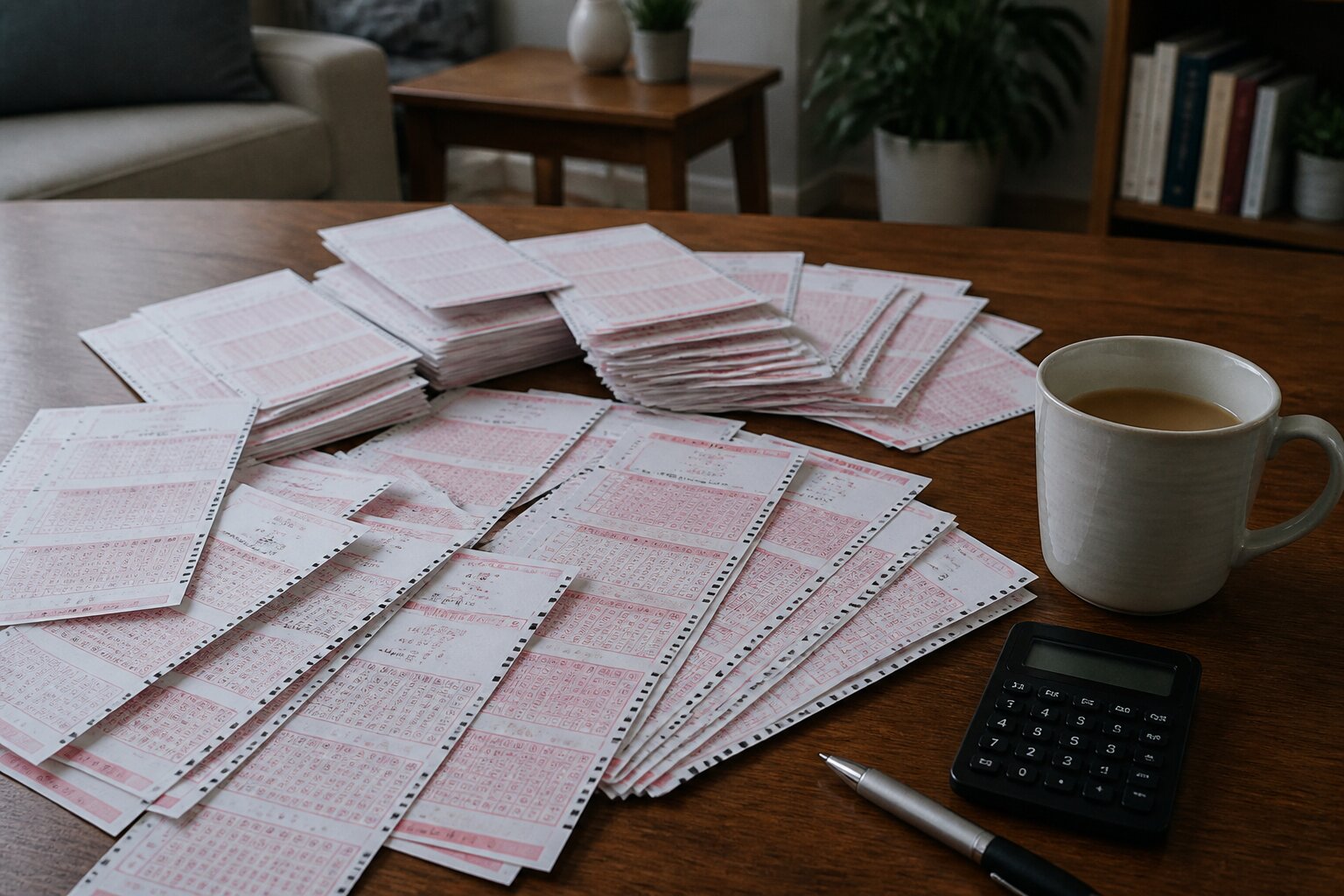
Ever wondered if you could guarantee a lottery win by buying every possible ticket combination? It sounds bold — an idea that pops up in films and online discussion.
Before you consider spending serious money, it’s worth examining whether buying every combination is even feasible, and whether it would actually make financial sense. Read on to separate the maths and reality from the hype.
Understanding How Lottery Combinations Work
A lottery draw picks a fixed number of balls from a larger set to form the winning line. For a typical six-from-59 game, each unique set of six numbers is one combination and every combination has exactly the same chance of being chosen. The total number of possible combinations is given by the mathematical combinations formula, which for a six-from-59 draw works out to tens of millions of different lines.
Every combination is independent of past draws, and the process is run under strict controls to ensure fairness. That means there are no trends or secret patterns to exploit; the probability attached to any single ticket in a draw is always the same. With that in mind, the next section looks at whether the law or operators would even allow someone to try buying all those combinations.
Is It Legally Possible to Buy Every Ticket?
There is nothing in itself unlawful about buying many tickets, but lotteries are regulated to protect fairness and players. Operators set practical limits on bulk purchases, monitor for unusual activity, and can refuse orders that risk disrupting normal play. Retailers and ticketing systems are not designed to process extreme volumes in a single draw, which creates both operational and regulatory barriers.
Attempting to acquire every combination would quickly run into these constraints. Aside from rules, the logistics of placing millions of entries within the sales window pose a further hurdle. Given those limits, the following section examines what the financial outlay would look like if one tried anyway.
Calculating the True Cost of Buying All Combinations
Cost is the clearest barrier. If each ticket costs £2 and there are over 45 million combinations, the sticker price for one-of-each exceeds £90 million for a single draw. That figure does not include the practical expenses of printing, storing, transporting or electronically managing such a volume of entries. Processing fees, staffing and secure handling would all add to the total.
Even after paying that sum, there is no certainty of a profitable outcome. Large jackpots can be shared among multiple winners, and smaller-tier prizes will not add up to cover a vast outlay. With costs and prize-sharing in view, the next section explains how the chances and outcomes combine to make profit unlikely.
Could You Actually Win? The Odds Explained
Mathematically, buying every combination in a draw would guarantee that one of your tickets matches the winning numbers. However, guarantee of a matching ticket is not the same as guarantee of a profit. Jackpot prizes can be shared, and the payout for a single draw depends on how many others hold winning lines. Additionally, some prize tiers are fixed or relatively small, so the aggregate return across all prizes often falls far short of the purchase cost in realistic scenarios.
Because each ticket’s probability of success is set by the game’s structure, no purchase strategy changes the fundamental odds. That reality undercuts any expectation that sheer volume will reliably turn a profit, which helps explain why attempts to buy every combination have not succeeded in practice.
Why Has Nobody Ever Bought All Tickets?
The combination of high cost, technological limits and operator safeguards has stopped anyone from completing a full-cover purchase. Systems must register each unique entry, meet cut-off times, and cope with secure handling in a way that is not feasible at the extreme scale required. Operators also enforce rules to prevent attempts that would impair the fairness or smooth running of the draw.
These practical obstacles are equally important to the regulatory ones, and together they make a full-cover strategy effectively impossible. To illustrate how these difficulties play out in real life, the next part looks at recorded attempts and what went wrong.
Myths About Guaranteed Lottery Wins
Stories about wheeling systems, prediction software, or guaranteed-win schemes are common but misleading. No mathematical trick or program can change the underlying probabilities of a properly conducted draw. Even methods that increase the number of unique combinations played do not overcome the risk of shared jackpots or the vast expense involved.
Many promotional claims gloss over the fact that lotteries are designed around random draws and fixed odds. Systems that promise certainty often rely on selective presentation of results or on assumptions that do not hold in practice. They may highlight occasional successes while ignoring the many more instances where backers see no return at all.
Claims of guaranteed profit typically ignore the realities of prize division and operational constraints. In large jackpots, multiple winners can split the top prize, dramatically reducing individual returns. Administrative fees, taxes where applicable, and the cost of acquiring and managing many tickets all eat into any theoretical advantage.
Understanding these limits is essential before weighing any large-scale spending on tickets. Responsible consideration includes acknowledging the low likelihood of success, the potential for shared wins, and the possibility of substantial net losses even when small prizes are won. With myths cleared up, the next section explores the financial and personal risks attached to such gambles.
Financial Risks and Potential Consequences
Large-scale ticket purchases carry obvious monetary risk. The expenditure can reach sums that would otherwise serve essential needs, create long-term financial stress, or produce unmanageable losses. For many, spending large amounts on entries represents an ongoing drain on disposable income, reducing the ability to save or meet regular bills and increasing the chance of borrowing to cover shortfalls. There is also the opportunity cost of funds tied up in tickets rather than being invested or used for other priorities.
Operational errors, missed deadlines or processing failures are additional hazards that can lead to unrecoverable spending. Mistakes such as double bookings, incorrect payment authorisations, expired payment methods or deadlines missed by seconds can all result in lost money that is rarely refunded. Technical issues with platforms, delays in processing or misunderstanding the terms and conditions may also mean purchases are invalid or not entered in time, leaving purchasers out of pocket and without recourse.
To help manage risk, players have access to a range of safeguards such as deposit limits, self-exclusion and support from independent organisations. Many platforms offer tools like time-outs, reality checks and voluntary limits that can be adjusted to control how much and how often someone plays. National self-exclusion schemes and independent support services can provide additional layers of protection and practical help for anyone concerned about their behaviour.
These tools aim to keep participation affordable and controlled, and where used correctly they can reduce harm and help keep gambling within safe limits. The following section gives a sense of how real attempts have fared, reinforcing why the approach is so fraught.
Are There Any Recorded Attempts or Famous Examples?
A few documented efforts to buy large numbers of tickets date back to earlier decades and often involved considerable planning. One notable case attempted a near-complete cover in a US state lottery, but it collapsed under the weight of printing, purchase cut-offs and handling problems. Many tickets remained unprocessed and the organisers did not achieve the intended coverage.
Such episodes highlight how technical, logistical and time-sensitive hurdles can defeat even well-funded schemes. Modern systems and tighter controls make similar attempts even less feasible today. With that context, consider what would happen if many people tried the same tactic at once.
What Would Happen If Everyone Tried This?
If a large number of players attempted to buy all combinations, ticketing infrastructure and retail operations would likely be overwhelmed. The result could be system failures, delayed draws and frustrated players who simply wanted to take part. Far from improving chances of profit, mass attempts would lead to wider prize sharing and substantial losses for many participants.
Regulators and operators would almost certainly respond with stricter purchase limits and enhanced monitoring to protect the integrity of the games. Such interventions would further reduce the viability of mass-buy strategies and reinforce the intended spirit of the lottery as a chance-based form of entertainment.
Conclusion: Is Buying All Lottery Tickets Ever Worth Considering?
Purchasing every possible lottery combination is not realistic or advisable. The enormous cost, combined with technical and regulatory barriers and the high likelihood of shared prizes, make the idea impractical for individuals or groups. Lotteries are structured to be random and fair, providing entertainment rather than assured returns.
If participation continues, keeping spending within affordable limits and using available controls helps ensure the activity remains safe and manageable. For anyone concerned about their play, help and support options exist to maintain healthy boundaries. Ultimately, the practical and financial realities make it clear that buying every combination is a theoretical curiosity rather than a sensible strategy.
**The information provided in this blog is intended for educational purposes and should not be construed as betting advice or a guarantee of success. Always gamble responsibly.