
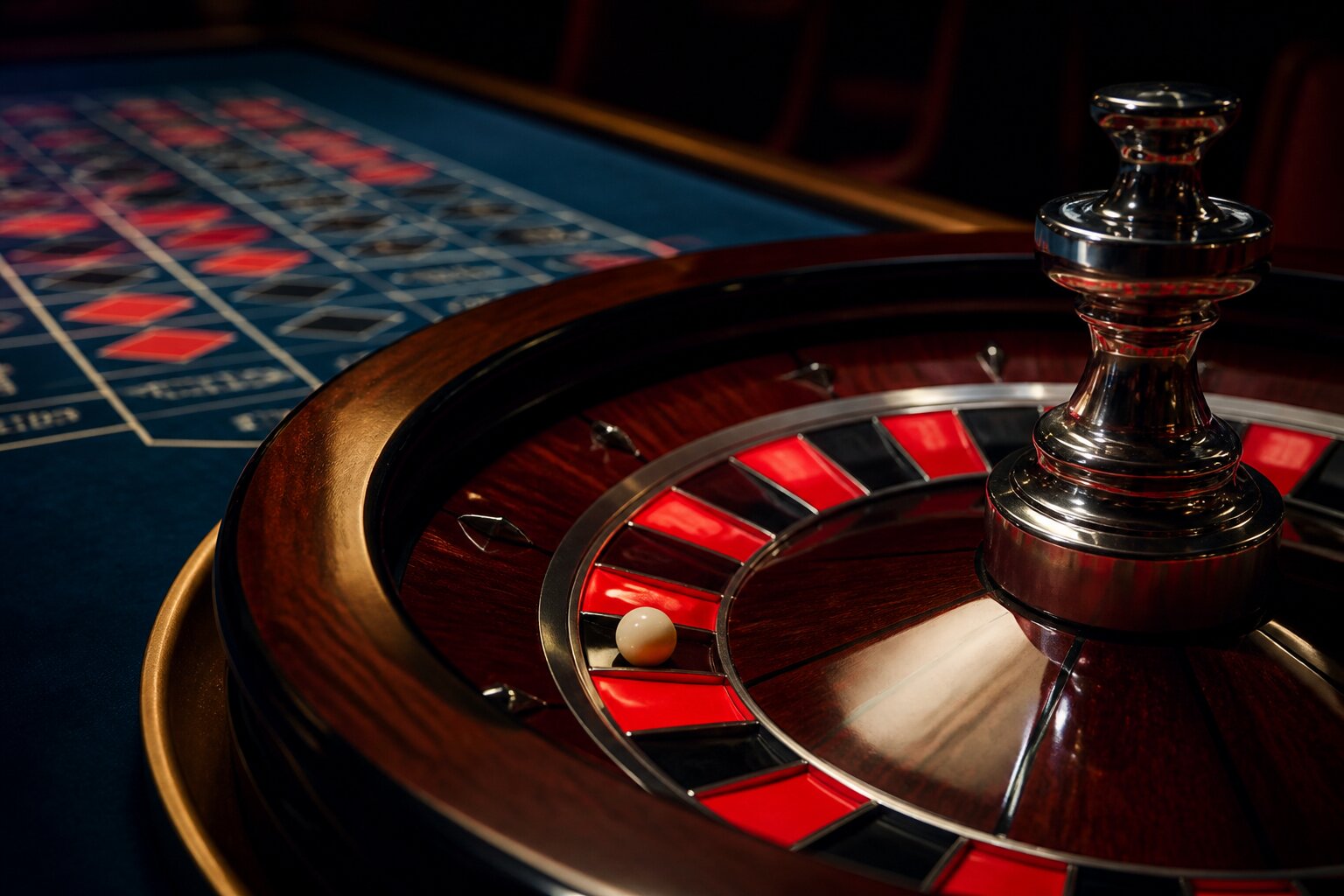
If you’ve ever watched the roulette wheel land on red several times in a row, you might have wondered whether the next spin will be different. That question crops up in casinos and online forums across the UK, and it’s often wrapped in a surprising amount of certainty.
Before placing chips because of a perceived trend, there are a few straightforward facts worth understanding. Many players make simple errors when interpreting streaks and probabilities, so a clear look at how the maths works helps separate fact from fiction.
Curious whether chasing these streaks gives a real edge or not? The following sections unpack the true odds, common misconceptions, and what to watch for at the table.
What Are the Odds of Red Appearing Consecutively in Roulette?
On a standard European roulette wheel there are 37 pockets: 18 red, 18 black and one green zero. Each spin is an independent event, and the probability of red on any single spin is 18/37, which is about 48.65%.
To find the chance of consecutive reds, multiply the single-spin probability for each spin in the sequence. For example:
- Two reds in a row: 0.4865 x 0.4865 ≈ 0.2367, or about 23.67%.
- Three reds: 0.4865^3 ≈ 0.1152, or roughly 11.52%.
- Five reds: 0.4865^5 ≈ 0.0521, or 5.21%.
- Ten reds: 0.4865^10 ≈ 0.0027, or 0.27%.
Those figures show how rapidly the probability falls as a streak grows. Knowing how to calculate these odds is useful when evaluating any claim about patterns; next we’ll look at the most common myths players use to justify pattern-based bets.
Common Myths About Back-To-Back Results
Misunderstandings about patterns and streaks are widespread, and they can nudge players toward poor choices. Two myths are especially persistent, and they are easy to believe because human brains look for order even in random events. Recognising these misconceptions helps people make calmer, more informed decisions when they play.
Myth: Patterns Predict Future Spins
Some players assume that visible patterns—alternating colours or runs of reds—signal a trend that will continue. Often this belief grows from seeing short stretches of similar outcomes and treating them as meaningful. In reality, the wheel does not build or remember patterns. Seeing a short-term pattern is simply how random data sometimes appears, not evidence of a predictable sequence.
This means that a sequence of results should not be treated as a reliable indicator of what will come next. Random processes routinely produce clusters and gaps, so what looks like a pattern can be nothing more than normal variation. Keeping this in mind reduces the temptation to chase perceived trends.
Myth: Streaks Make the Opposite More Likely
Another frequent belief is that after a long run of the same colour the opposite colour is “due.” Because every spin is independent, the chance of red or black on the next spin stays at the same percentage regardless of prior results. Long runs can feel surprising, but they are part of normal variability rather than a signal that the next outcome will correct the sequence.
People may feel an urge to alter their bets based on recent streaks, thinking they can exploit a coming reversal. However, treating each spin as isolated avoids misleading assumptions and helps maintain a consistent approach. Accepting independence of spins also highlights why strategies that rely on presumed corrections do not change the overall odds.
Understanding these myths clears the way for a clearer explanation of how probability actually works in roulette. It puts emphasis on treating outcomes as independent events and recognising that randomness will sometimes appear to form patterns without any causal link.
How Probability in Roulette Really Works
Probability here is simple arithmetic based on fixed outcomes per spin. With 37 pockets, each spin offers the same set of possible results and the same probabilities. This is the defining feature of an independent event: the outcome of one spin does not change the mathematics governing the next.
When multiple spins are considered together, the calculation uses multiplication of the single-spin probability for each spin in the chain, as shown earlier. That method gives precise chances for any specific sequence, and it always starts from the same single-spin value because the underlying circumstances do not change from spin to spin.
Having covered both common myths and the maths, the next question is whether anything about previous spins can influence the next result — and what exceptions, if any, might exist.
Does Previous Spin Colour Affect the Next Spin?
The colour of the last spin does not influence the next one; the wheel does not have memory or momentum. Each spin carries the same probabilities for red, black or green zero as any other spin, and that remains true no matter how long a streak has been observed.
Practical examples help make this concrete: whether there have been six blacks in a row, ten reds in a row, or a mixed sequence, the next spin still reflects the same single-spin probabilities. Because prior results do not affect the next one, strategies that rely on betting against or for “due” outcomes do not change the long-term mathematical expectation.
With the basic mechanics clear, some readers wonder whether physical imperfections ever create dependable departures from the expected probabilities — which leads into the topic of table bias.
Understanding Table Bias and Its Rarity
Table bias refers to physical faults in a roulette wheel or its surroundings that cause certain pockets to come up more often than they should. Historical cases involved worn wheels, slight tilts, or manufacturing flaws; these could make particular numbers or sections more frequent than pure randomness predicts.
Today, genuine table bias is very uncommon. Modern casinos and online operators use rigorous maintenance, precise manufacturing, and routine checks. Online games use Random Number Generators which are tested and audited to confirm that outcomes meet statistical expectations. When issues do arise, they are typically detected and corrected quickly.
Because bias is rare, the vast majority of play reflects the independent-event mathematics already discussed. Even so, awareness of the possibility helps explain why extraordinary claims about persistent patterns should be treated with scepticism. That practical caution leads naturally into how to manage play and expectations.
Responsible Play and Managing Expectations
Roulette is a form of entertainment with set odds, not a way to earn money. Keeping play within affordable limits and maintaining clear expectations are the most reliable ways to enjoy the game without undue risk.
Deciding on a budget, taking breaks, and avoiding attempts to recover losses are sensible habits. If gambling stops being enjoyable or feels hard to control, confidential support services in the UK, such as GamCare and BeGambleAware, can offer help and guidance.
Keep outcomes in perspective, play within your means, and remember that mathematical probabilities govern long-term results. If you want to explore more about odds, bets and how different games compare, our guides explain the key points in plain language and without hype.
Discover Casino Games at Star Slots
Ever thought about exploring something new for a bit of fun? Our site is always open for you to see what’s on offer, with something for everyone to get stuck into.
Getting set up is straightforward — just create an account, make a deposit and you’re ready to play. We’d love for you to join us and see what you might enjoy.
**The information provided in this blog is intended for educational purposes and should not be construed as betting advice or a guarantee of success. Always gamble responsibly.