
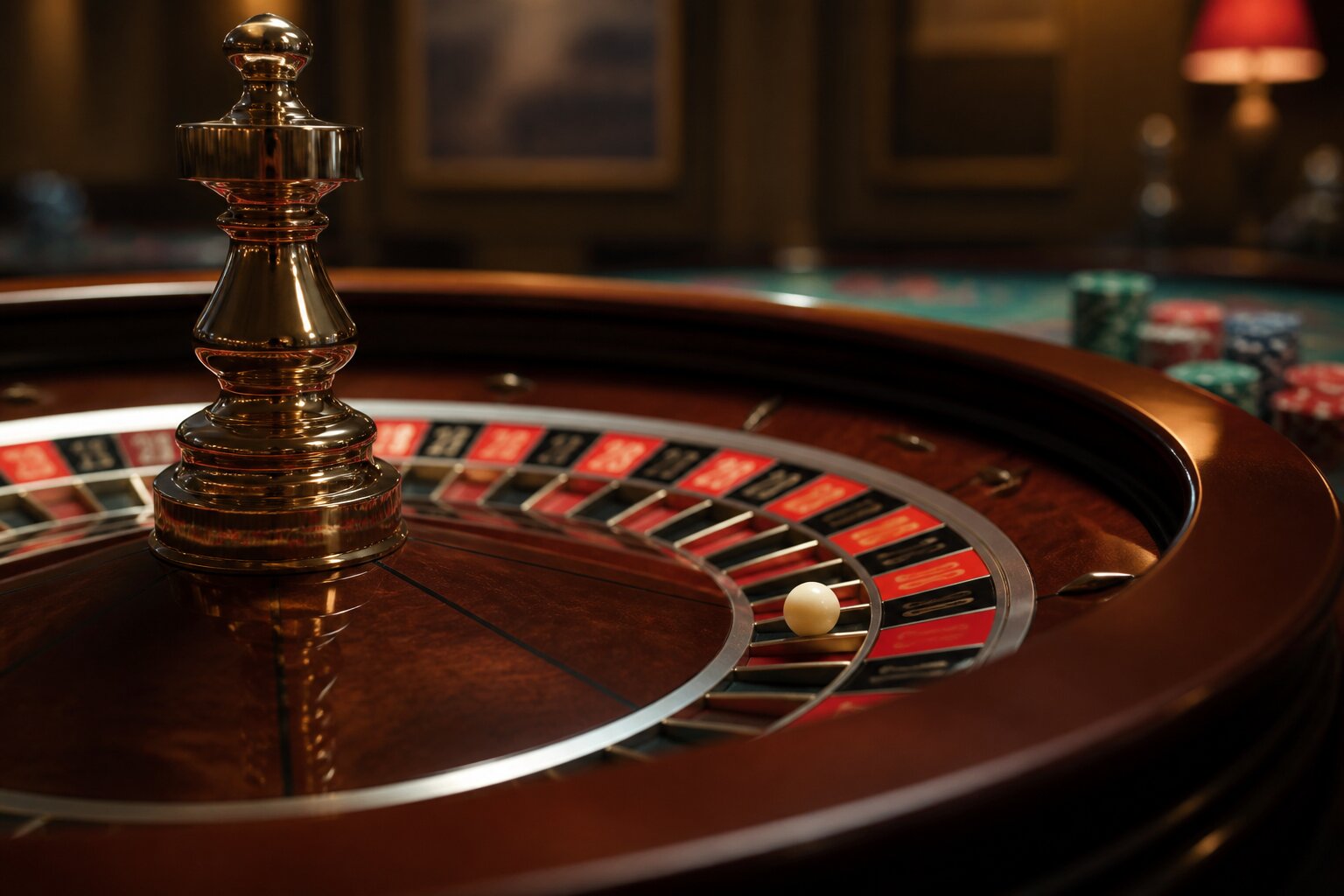
Ever wondered what your chances are of landing the same number twice in a row at the roulette table? Or how the odds really stack up when you place a straight-up bet?
This guide sets out the probabilities, explains what house edge means for your play, and describes the outcomes you can expect, all in plain English so you can make informed choices before you spin.
Ready to get clear numbers and sensible context? Let’s take a closer look at how it all works.
What Are the Odds of the Same Number in Roulette?
Landing the same number on two consecutive spins is a rare event. To calculate the odds, the first step is to know how many pockets are on the wheel.
A European roulette wheel has 37 pockets (numbers 1–36 and a single zero). An American wheel has 38 pockets (numbers 1–36, a single zero and a double zero). Each pocket is equally likely to come up on any given spin.
The probability of hitting a chosen number on one spin is 1 in 37 for European roulette (about 2.70%) and 1 in 38 for American roulette (about 2.63%). For that same number to appear on two consecutive spins, multiply the single-spin probability by itself:
- European roulette: 1/37 × 1/37 = 1/1,369 (about 0.073%).
- American roulette: 1/38 × 1/38 = 1/1,444 (about 0.069%).
So, a European example: betting on number 17 and seeing it land twice in a row is a 1 in 1,369 event. Extending to three repeats reduces the chance further, to 1 in 50,653 on a European wheel. These figures reflect the random nature of each spin and why repeated occurrences are uncommon.
If you want to see how these base probabilities relate to the casino’s cut and what that means for a straight-up bet, the next section explains probability more broadly and then links it to house edge.
Understanding Probability and Outcomes
Probability gives a clear measure of how likely each result is. In roulette every spin is independent, so the probability of a number, colour or sector does not change with past results. Whether a number has just come up or it has not appeared for many spins, its chance on the next spin remains the same.
When combining probabilities, multiplication shows how quickly overall chances drop. That is why two identical outcomes in succession, or even longer streaks, are so infrequent. Observing patterns in past spins does not alter the maths for future spins.
Understanding this helps set realistic expectations. It also explains why betting strategies that rely on perceived patterns cannot change the inherent odds. Knowing the probabilities lets you decide how much to stake and what outcomes to expect, without implying any ability to predict what will come next.
With those basics set, it is useful to compare the two main wheel types and see how the extra pocket on the American wheel changes both probabilities and the long-term financial balance of the game.
Comparing Single-Zero and Double-Zero Wheels
Roulette is offered in single-zero and double-zero formats, and the extra pocket on a double-zero wheel alters the maths in a straightforward way. The European (single-zero) wheel has 37 pockets; the American (double-zero) wheel has 38. More pockets mean a slightly lower chance of any one outcome on a single spin.
Impact on single-number probability:
- European: 1 in 37, or 2.70%.
- American: 1 in 38, or 2.63%.
That small difference in probability has a direct effect on the house advantage. On European wheels the house edge is 2.70%. On American wheels the house edge is 5.26%. The difference exists because payouts are the same for a straight-up win on both wheels, but the chance of winning is lower on the American wheel.
Payouts for a straight-up bet are 35 to 1 in both formats. Because the payout does not match the true odds (36 to 1 on a 37-pocket wheel, or 37 to 1 on a 38-pocket wheel), the casino retains a long-term advantage. Next, we look specifically at how that house edge influences betting outcomes when the same number is your focus.
How Does the House Edge Affect Betting on the Same Number?
The house edge is the long-term expected percentage that the casino keeps from wagers. For single-number bets, it arises because the payout is slightly less generous than the true odds.
On a European wheel with a 2.70% house edge, the expected loss over time is £2.70 for every £100 wagered. On an American wheel with a 5.26% house edge, the expected loss is £5.26 per £100. A single win will still pay 35 to 1, returning the stake and £35 in profit, but the mismatch between payout and true probability is what produces the edge.
This maths means repeating the same straight-up bet does not change the expected return. Occasional large wins can occur, but over many spins the house edge determines the average outcome. If your interest is how often the same number repeats, the earlier probability calculations remain the basis, while the house edge explains why the casino keeps a portion of the stakes in the long run.
Having seen how the house retains an edge, it helps to consider what actually shapes each spin and why apparent streaks should be treated as coincidence rather than as reliable signals.
Factors That Influence Outcomes in Consecutive Spins
Each spin result is produced by a process intended to be random, and in regulated environments the outcome is unpredictable and independent of previous spins. Whether in a physical casino or online via a certified random number generator, the mechanism ensures every spin starts with the same set of chances.
People notice streaks and patterns because even purely random sequences produce clusters from time to time. These are natural statistical occurrences rather than evidence of an underlying trend. That is why pattern-chasing or increasing bets after an outcome does not improve long-term returns.
Keeping play within sensible limits and understanding the separation between occasional short-term wins and long-term expectation helps maintain a clear perspective. The following section addresses common misunderstandings people have about repeated numbers and betting systems, clarifying what is and is not supported by the maths.
Common Misconceptions About Same Number Occurrences
-
Myth: A number that has just landed is more likely to repeat.
Fact: Each spin is independent, so the chance of any number appearing on the next spin is unchanged. -
Myth: Certain numbers are ‘hot’ or ‘due’ to appear again soon.
Fact: All numbers have equal probability on each spin; perceived hot streaks are coincidental. -
Myth: Seeing the same number twice means a streak is forming.
Fact: Two identical outcomes in succession can happen, but it is a rare coincidence rather than evidence of a predictable pattern. -
Myth: Betting systems that follow patterns can guarantee a win.
Fact: No system can alter the house edge or the fixed probabilities of outcomes. -
Myth: Casinos or software prevent repeated results by manipulation.
Fact: Properly regulated venues and certified random number generators are tested to ensure fair, unpredictable outcomes.
Understanding these points keeps expectations aligned with how the game actually behaves and supports sensible choices at the table. If you want to explore particular probabilities or the balance between risk and payout further, those topics can be examined in depth, but for now the key takeaway is clear: the maths governs outcomes, and the house edge determines long-term return.
Sticking to clear facts about probability and house advantage helps you play with realistic expectations and makes the experience more straightforward and informative.
Play Online Casino Games at Star Slots
Joining our site is a great way to enjoy the fun and excitement of online casino games in a friendly and welcoming setting. We’re here to make your experience as enjoyable and straightforward as possible, so you can relax and play at your own pace.
Getting started couldn’t be easier – just create an account, make a deposit and you’re ready to explore what we have to offer. We’d love to welcome you to our community soon!
**The information provided in this blog is intended for educational purposes and should not be construed as betting advice or a guarantee of success. Always gamble responsibly.