
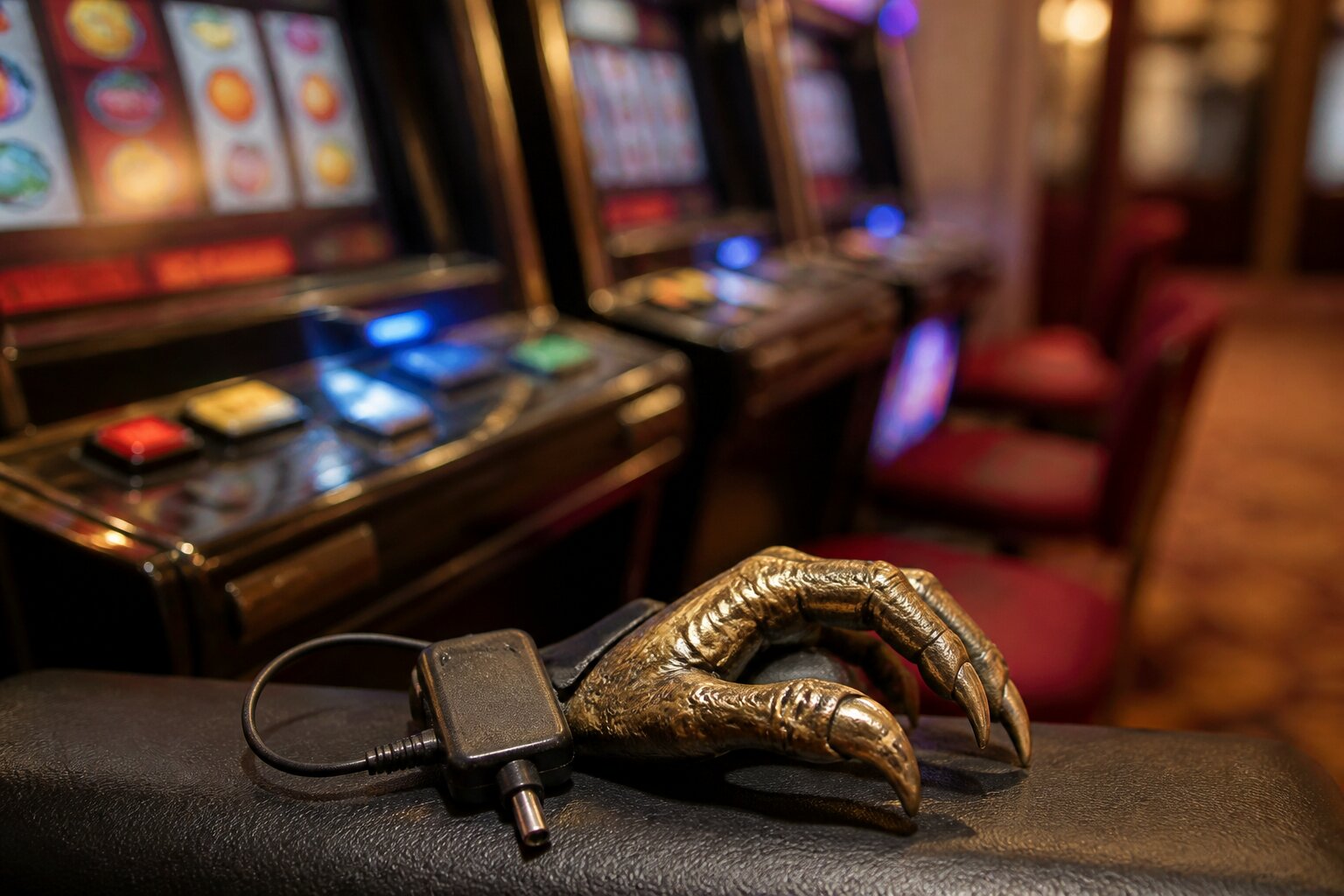
Ever wondered why stories about pub fruit machines and cheating gadgets keep cropping up? The monkey paw is one of the better-known examples: a simple, homemade tool that became notorious for exploiting older slot machines. This article explains what the device is, how it was used, why those methods failed against modern machines, and how venues now stop this sort of tampering.
Read on to learn the technical details and the wider context, including common myths and the historical response from operators and regulators.
What Is the Monkey Paw Tool for Slot Machines?
The monkey paw is a basic, handmade tool used to interfere with mechanical slot or fruit machines. It usually looks like a long, bent piece of wire—sometimes with a small loop or claw at the tip—shaped so it can be slid into a coin slot or payout chute. Users attempt to reach internal mechanisms that control coin detection or payouts, with the intention of triggering a release of coins or a false credit.
Different versions of the tool have circulated under various names—slot keys, bent wire tools or simply wires—but they share the same aim: unauthorised physical access to a machine’s moving parts. Because the device targets mechanical components, it was most effective against older machines whose internals relied heavily on levers, switches and springs.
Possession or use of such a tool is a criminal offence under UK law. Interfering with gaming machines undermines fair play, harms operators and puts the individual at legal risk.
How Does the Device Interact with Slot Machine Mechanisms?
The monkey paw functions by physically reaching into narrow openings and manipulating parts that should only move when a legitimate coin or payout event occurs. Inserted into the coin slot or payout chute, the hooked end can be used to tug a lever, depress a switch or momentarily bypass a sensor. In some cases the wire could be positioned to mimic the movement a genuine coin would make, causing the machine to register a credit or to release coins.
Older, mechanical fruit machines were particularly vulnerable because their payouts depended on simple mechanical linkages. A thin wire could reach and disturb those linkages without opening the cabinet. Electronic machines, by contrast, use sealed components, tamper switches and sensor logic that do not respond to crude mechanical interference.
It’s also important to note the physical hazards: inserting metal into coin chutes risks damage to the machine and personal injury through cuts or contact with electrical parts. Any such attempt is unlawful and can lead to prosecution.
Common Myths & Misconceptions About the Monkey Paw Tool
Stories and exaggerations have surrounded the monkey paw for decades, so it helps to separate myth from reality.
Does the Monkey Paw Really Cheat Slot Machines?
One persistent belief is that the device guarantees large wins. In truth, it was never a reliable method for securing predictable or repeatable payouts; at best it produced sporadic, small gains and often failed outright. Another myth holds that venues cannot detect the device. In practice, staff and surveillance systems are trained to spot tampering and to investigate anything unusual.
Some also claim the tool still works on modern machines. Today’s terminals incorporate tamper-proof construction and sensor arrays that render simple wires ineffective, and attempts to force such devices in will often trigger alarms or be visible on camera.
Is the Monkey Paw Legal or Safe to Use?
There is no legal ambiguity here: using or possessing tools intended to interfere with gaming equipment is an offence under the Gambling Act 2005 and related legislation. Prosecutions, fines and other penalties have followed incidents where people were caught attempting to cheat machines.
Safety is another concern. Wires and improvised hooks can cause cuts, eye injuries or electrical shocks if internal circuits are disturbed. Beyond physical harm, tampering damages equipment and harms the wider community by eroding trust in regulated play.
With the myths addressed, the next section looks at how cheating techniques evolved alongside the machines they targeted.
History of Slot Machine Tampering Devices
Cheating attempts go back as long as slot machines have existed. In Britain, early scams were simple: the stringed coin—an actual coin attached to thread—let someone trigger a spin and retrieve the coin afterwards. As technology advanced, so did the schemes.
The monkey paw emerged in response to mechanical machines with exposed linkages. Later, as electronic elements were introduced, criminals experimented with light-based tricks, microchip tampering and counterfeit tokens known as slugs. Each new technique prompted an industry response: improvements to hardware, enhanced validations for coins and notes, and tighter regulatory measures.
The Gambling Act 2005 and ongoing technical upgrades made many old scams unworkable. Regular inspections and licensing requirements further reduced opportunities for tampering, turning crude tools into relics and shifting criminal focus toward more sophisticated fraud.
How Do Casinos Prevent Device-Based Cheating?
Operators deploy a mix of physical, electronic and procedural measures specifically designed to stop device-based cheating. Machines now include robust locks and internal barriers so that only authorised staff can access critical components. After maintenance, units are often sealed and logged to prevent unauthorised entry.
Sensors within coin and note validators detect foreign objects and tampering attempts, while anti-spoofing logic rejects anything that fails to meet strict electrical or mechanical profiles for genuine currency. CCTV and attentive floor staff provide an additional layer of deterrence and evidence collection when incidents occur.
Remote monitoring software examines machine logs for anomalies in payout patterns and sensor events, allowing quick investigation. Where tampering is suspected, operators work with authorities to pursue offenders and to maintain the integrity of their venues.
Licensed operators are required to follow regulatory standards, conduct audits and keep equipment up to date to protect fair play and the safety of their customers and staff.
This review shows how simple tools once exploited weak points in mechanical machines, and how industry responses have made such methods ineffective and risky. The practical lesson is clear: tampering is illegal, dangerous and ultimately futile against today’s safeguards.
Play Online Slots at Star Slots
We welcome you to enjoy a world of entertainment with us, all from the comfort of home. Take things at your own pace and explore what we have to offer whenever you feel like playing.
Getting started is straightforward: simply create an account, make a deposit and you will be able to join in the fun. We look forward to seeing you at Star Slots.
**The information provided in this blog is intended for educational purposes and should not be construed as betting advice or a guarantee of success. Always gamble responsibly.