
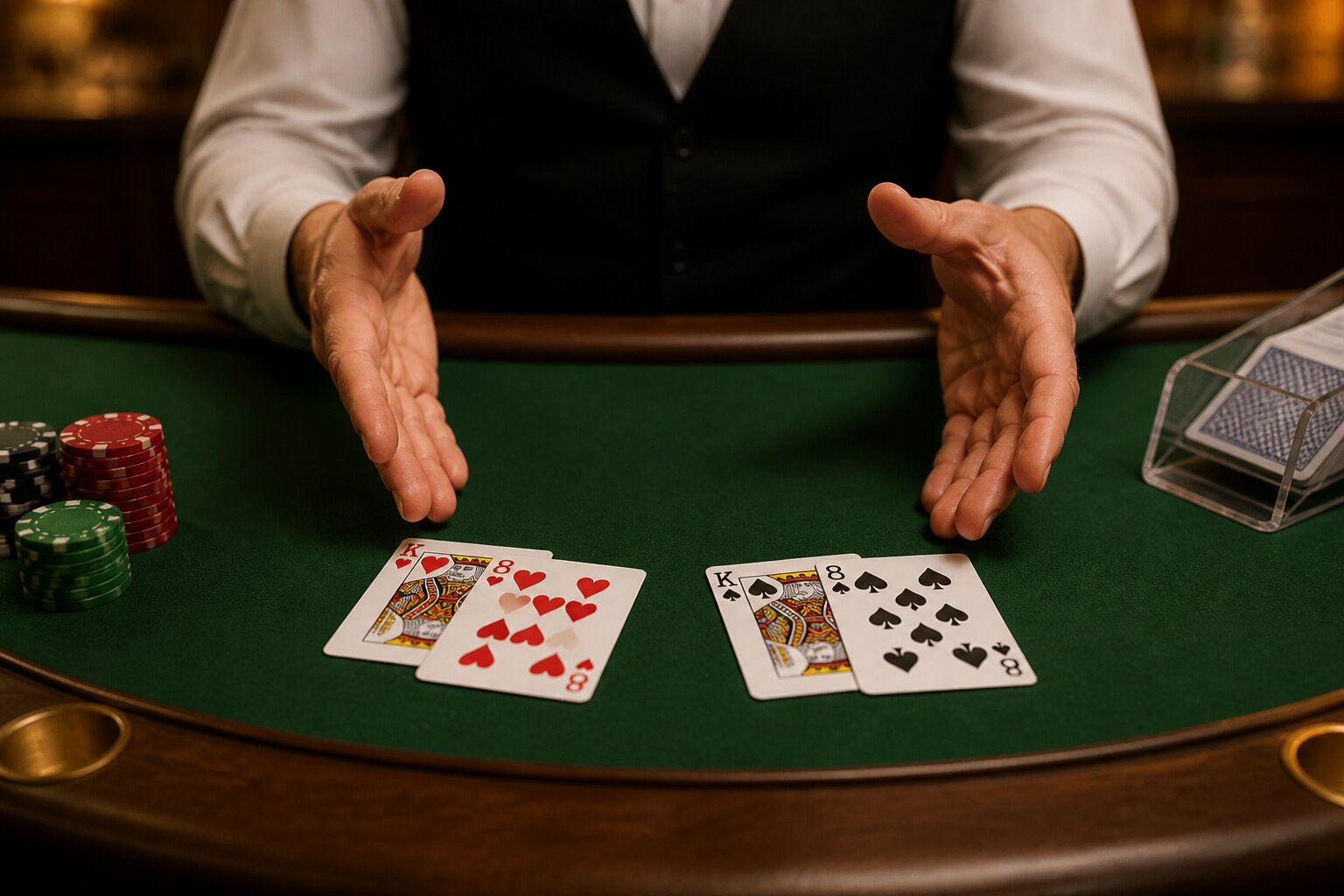
Blackjack looks straightforward, but a few terms can throw new players off. One of the most common is “push”.
If you’ve had your chips returned after a hand without winning or losing, that was a push. This guide explains what a push is, when it happens, and what it means for your balance and strategy.
Read on and you’ll have a clear picture of ties in blackjack and how they fit into the game.
What Is a Push in Blackjack?
A push in blackjack is simply a tie: your final hand total equals the dealer’s final total.
When that happens, the casino returns your original stake. You don’t receive winnings, but you also don’t lose the bet. The round ends for you with no change to your balance.
A push can only occur if your hand is still active at the end of the round. If you have already exceeded 21, your hand has gone bust and the outcome is a loss rather than a push.
This outcome is baked into the rules of blackjack, so it can occur at any table, whether you are playing in person or online.
When Does a Push Occur in the Game?
A push happens after all cards are played and both hands are compared. If your total and the dealer’s total match exactly, the dealer does not collect your bet and your stake is returned.
Common examples include both hands finishing on totals like 18, 19 or 20. These outcomes can occur whether the hands were reached by drawing several cards or by standing early.
Pushes also occur when both player and dealer receive a natural blackjack, that first-two-cards total of 21. In that case neither party wins and the original wager is returned.
Because of how the dealer must draw — usually hitting on totals below a set number and standing on higher totals — situations arise frequently where totals line up. Pushes are simply one of the routine outcomes you should expect, alongside wins and losses.
Examples of typical push scenarios:
- Both player and dealer end with the same non-blackjack total, such as 18, 19 or 20.
- Both player and dealer are dealt a natural blackjack in the first two cards.
- The player stands and the dealer draws to a matching total under the house rules.
Push vs Win vs Loss: What’s the Difference?
Every blackjack hand ends as a win, loss or push. Knowing which of these outcomes occurs tells you what happens to the money you staked and helps you make informed decisions at the table.
- A win occurs when your hand beats the dealer’s without exceeding 21. In this case you receive your original bet back plus the payout, which depends on the game rules and the type of win.
- A loss happens if your hand is beaten by the dealer or if you go over 21. When you lose, the house keeps your stake and it is removed from your balance for that round.
- A push returns your original bet because both totals are the same. A push is neither a win nor a loss: your stake is returned and your bankroll remains unchanged for that hand.
Understanding these distinctions helps you follow what happens to your money after each round. It also makes it easier to see how different plays affect your bankroll over time and to manage your risk responsibly.
What Happens to Your Bet in a Push?
When a push occurs, your bet is handed back in full. There is no extra money paid out and nothing is taken away.
That returned stake is simply returned to your account or placed back on the table and can be handled in a couple of ways:
- used to stake the next hand or spin;
- withdrawn, subject to the casino’s usual withdrawal procedures and any verification checks.
The key point is that a push leaves your bankroll unchanged compared with the start of that hand. It does not count as a win or a loss for that round, and it does not affect any ongoing win streaks or losing runs other than preserving your funds.
Bear in mind that processing times and the exact procedure for returned stakes can vary between operators, so check the site’s terms and account statements if you need confirmation. If you have concerns about your balance or specific transactions, contact customer support for clarification.
Common Scenarios Leading to a Push
Several typical situations produce a push at the table.
One frequent case is matched totals after dealer draws—if you stand on 19 and the dealer eventually reaches 19, the round is a tie. Both players receiving natural blackjacks also leads to a push, with the dealer typically paying wins for player blackjacks only when the dealer does not have one.
Other scenarios include hands that arrive at the same total through different paths: you might reach 20 with two cards, while the dealer builds to 20 through drawing. The end result is the same—a push.
These examples are part of the game’s mechanics rather than exceptional events.
Do Pushes Affect Your Blackjack Odds?
Pushes themselves do not change the payout on a single hand, but they do influence how often you see wins or losses across many hands. Because pushes return the stake, they reduce the number of resolved outcomes where money actually changes hands.
Statistically, the frequency of pushes is accounted for in measures of house edge and expected return. From a practical viewpoint, a string of pushes will leave your balance steady for a time, while wins and losses move it up or down.
Remember that each hand is treated separately by the game, so a push in one round does not alter the rules or probabilities for the next.
Can You Lose Money on a Push?
No. You cannot lose money when a push happens. Your original wager is returned in full, so your bankroll is the same as it was before that hand.
A push means neither you nor the dealer wins, so there is no payout and no deduction. Settlement usually happens immediately at the end of the hand, with your stake returned to your account or placed back on the table according to the house rules.
What can still reduce your balance are:
- hands you lose, where your stake is taken by the house
- stakes you place in later rounds, which become at risk once a new hand starts
- side bets or optional wagers that do not tie into the main hand outcome
If you are playing in a casino or online, check the specific rules for how returns are handled and whether any fees apply. If you have concerns about your balance, contact customer support or use responsible gambling tools to manage your play.
Push Myths in Blackjack: Truths and Misconceptions
A few misconceptions surround pushes. Common examples include:
- The idea that a push means you “nearly” won or that it is somehow a penalty. In reality, a push is neutral: your stake is returned and no money changes hands.
- The belief that pushes indicate a pattern that will influence subsequent hands. Each hand is independent, subject to the same rules and house edge as any other.
Some players also think pushes are rarer or tied to specific casinos. In fact, pushes are a standard outcome in regulated blackjack games and appear whenever the player and dealer hands tie according to the rules in play.
Separating these myths from the rule helps avoid misunderstandings at the table. Knowing that a push is neither a loss nor a win, and that it does not affect the odds of future hands, can reduce frustration and support clearer decision making while playing.
How Do Casinos Handle Push Outcomes?
Casinos return the stake to the player when a hand results in a push. For regulated operators, this process is straightforward and implemented consistently across tables and digital systems.
Online platforms usually update the player balance immediately; at live tables the dealer will collect and then return the bet or push the chips back, depending on the table’s operating style. Rules about payouts for natural blackjacks and other special cases remain clearly stated in casino rules so players know how ties are settled before they play.
Where clarity is needed, casinos publish their game rules so players can confirm how pushes and other outcomes are processed.
Summary of Key Takeaways on Pushes in Blackjack
A push is a tie between your hand and the dealer’s, and it leads to your original bet being returned.
Pushes occur when both hands finish with the same value, including when both hands are natural blackjacks. They are a normal, rule-driven outcome of the game and are handled consistently by regulated operators.
Keep in mind the broader picture: pushes preserve your stake for that hand, but wins and losses determine overall results across a session. If you choose to continue playing, do so with limits in mind and only using money you can afford to lose.
**The information provided in this blog is intended for educational purposes and should not be construed as betting advice or a guarantee of success. Always gamble responsibly.